The NARM Approach – A Relational Way of Working with Developmental Trauma
The NARM approach (NeuroAffective Relational Model™) is a relational approach to working with developmental trauma.
Many people experience inner tension or recurring patterns that show up in everyday life – in relationships, in the way they relate to themselves, or in dealing with closeness, boundaries, and emotions. Often, there is a sense that something is at work without being easy to name.
NARM focuses on what is showing up in our present experience. Rather than analysing the past in detail, we explore how we relate to ourselves and others today.
At the heart of this work is the question of how greater awareness, self-regulation, and freedom of choice can develop in the here and now.
Growth is not understood as a process of fixing something, but as a living process that unfolds through connection.
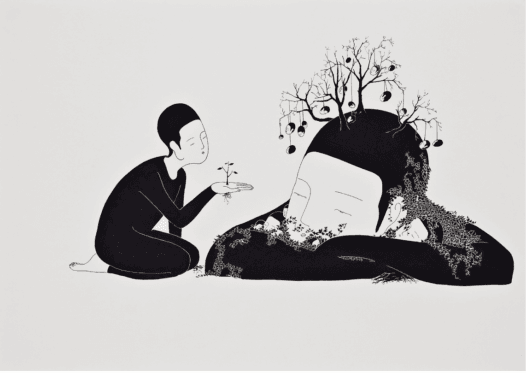
drawing by Moonassi
What does the method focus on?
How does NARM show up in everyday life?
In everyday life, there are often situations in which we feel internally stuck. Relationships seem to follow the same patterns, closeness can feel difficult or distant, and boundaries may be hard to set – or become very rigid.
Some people experience a deep sense of exhaustion or an inner dialogue that rarely becomes quiet.
In NARM work, we explore how these patterns show up in present experience – not as something “wrong”, but as an expression of ways of adapting that once made sense.
By exploring together what is happening in the here and now, the difference between past experiences and the present situation can gradually become more noticeable.
Over time, this can create more inner space and a greater sense of choice – making it possible to relate to ourselves and others more consciously.
The Therapeutic Space in NARM
In a safe and supportive setting, I invite clients to gently come into contact with their inner experience.
With careful attention, thoughts, emotions, and physical sensations can become more noticeable.
Open and inviting questions help us explore emotional reactions and consider whether certain inner attitudes or ways of responding are still helpful today.
The aim is not to immediately change or overcome anything, but first to notice and understand what is showing up.
This can create space for a deeper understanding of yourself. Connections become clearer and can be viewed with greater compassion.
Over the course of this work, a greater sense of inner freedom often develops. New perspectives can emerge, making it possible to stay more consciously connected with yourself and others.

Five Survival Styles
In the NeuroAffective Relational Model™ (NARM), development is understood as a movement towards connection – with ourselves, with others, and with life.
This movement unfolds across five central areas of development that begin to emerge in early childhood.
Each of these areas represents a capacity that helps us feel safe and connected. When development in one of these areas was disrupted, the ways we adapted were usually attempts to protect ourselves.
In therapy, the aim is to reconnect with these natural movements – not by “repairing” the past, but by developing greater connection in the here and now.
Over time, more space can emerge – for presence, self-acceptance, and the experience of connection.
“Healing happens where connection becomes possible.”
— inspired by Laurence Heller

Connection
The capacity to be connected with ourselves and with others does not develop on its own.
It grows when we feel seen, welcomed, and safe.
When this experience is missing or interrupted, it can become more difficult later in life to allow closeness or to truly sense ourselves.
In therapy, we gently work towards strengthening this connection – at your own pace and in the here and now.

Attunement
Over time, we learn to recognise and express our needs.
When our experience is seen and understood, trust can develop – trust in what we feel and in the possibility of sharing our needs with others.
When this experience is missing, it can become more difficult later in life to clearly sense or communicate our own needs.
In therapy, we gently work towards strengthening this connection to our needs.

Trust
Trust grows when we are able to stay connected with ourselves.
It becomes possible to open up to others without losing ourselves in the process. Relationships do not have to be shaped by dependency, but can be grounded in inner security and mutual respect.
This can create greater stability – in our relationships with others and in our experience of ourselves.

Autonomy
Autonomy means being able to recognise and express our own boundaries.
It becomes possible to say “no” without being overwhelmed by guilt or shame. This can bring greater clarity to our inner experience and to our relationships with others.
Over time, we can increasingly shape our lives around our own values and needs.

Love and Sexuality
Love and sexuality can be expressions of connection – with ourselves and with others.
When we remain connected with our own experience, it becomes possible to engage with others openly and respectfully.
Closeness and intimacy do not have to be shaped by insecurity or tension, but can be grounded in mutual respect and a sense of inner alignment.
Frequently Asked Questions
Developmental trauma can result from prolonged stressful or difficult experiences, often during childhood or early attachment relationships. These may include emotional neglect, repeated experiences of insecurity in relationships, or growing up in an environment with little stability and reliable support.
These experiences can shape how we experience ourselves, how we relate to our emotions, and how we connect with others.
Shock trauma, on the other hand, can result from a sudden, overwhelming event – such as an accident, an experience of violence, or a natural disaster. It is often accompanied by intense physical and emotional reactions.
Put simply:
Shock trauma is about what overwhelmed us in a particular moment.
Developmental trauma is about what was missing over time.
This work is for adults who want to explore the effects of developmental trauma, relationship dynamics, or recurring inner patterns.
It is not suitable for acute crises or severe psychiatric conditions that require inpatient or intensive psychiatric care. In these situations, appropriate medical or psychiatric support is important.
Sessions take place via video call and usually last 60 minutes.
At the beginning, we take some time to clarify what feels most important right now. In our work together, we focus on current experiences, inner tensions, or relationship patterns that show up in the here and now.
The aim is not to repeatedly revisit distressing memories, but to carefully explore what is present and noticeable in the moment.
All you need is a quiet, private space and a stable internet connection. Many people find it helpful to work from the familiarity of their own surroundings.
NARM is present-focused.
Rather than focusing on distressing memories, the work explores the protective strategies and relationship patterns that are active in your life today.
Instead of repeatedly revisiting the past, we pay attention to what is showing up in the here and now – in your experience, in connection with others, and in the body.
The aim is not to force change, but to explore with curiosity and care how old patterns continue to shape your experience today.
Over time, this can support a greater sense of connection with yourself and more freedom of choice – without pushing you beyond what feels manageable or requiring you to relive traumatic experiences.
My services are not suitable for acute or urgent crisis situations. In these cases, it is important to seek immediate support from emergency medical, psychiatric, or psychosocial services.
In a life-threatening emergency, call 112. For urgent medical help that is not life-threatening, you can contact the medical on-call service on 116117.
In Berlin, you can also contact the Berlin Crisis Service for support with psychosocial crises and acute mental health emergencies.
If your situation is stable enough to plan an appointment, it may be helpful to arrange an initial consultation with a psychotherapist, psychiatrist, or doctor with psychotherapeutic expertise.
If you are unsure whether my services are suitable for you at the moment, we can discuss this in an initial consultation – provided you are not currently experiencing an acute crisis.
The length of the process varies from person to person.
For an initial period of more in-depth work, I generally recommend around three months (8–12 sessions). This gives us time to develop a deeper understanding of the patterns involved and to support initial changes in becoming more stable over time.
After that, we can decide together whether and how you would like to continue.
A 50-minute session costs €100, both online and in person in Berlin.
Location:
Jetzt und Hier
Auguststraße 65
10117 Berlin-Mitte
My practice is private-pay only.
The initial consultation (around 20 minutes) is free of charge.
Yes. Many people come to work with me after previous experiences of therapy, especially when they want to understand certain patterns more deeply or create more lasting change.
NARM focuses less on the content of past experiences and more on the relationship patterns and protective strategies that are active in the here and now. This can bring new depth and clarity even to issues you may already be familiar with.

